Responsibility first
Begin with a named GDPR owner and a governance logic, rather than treating compliance as a last-minute legal checkbox.
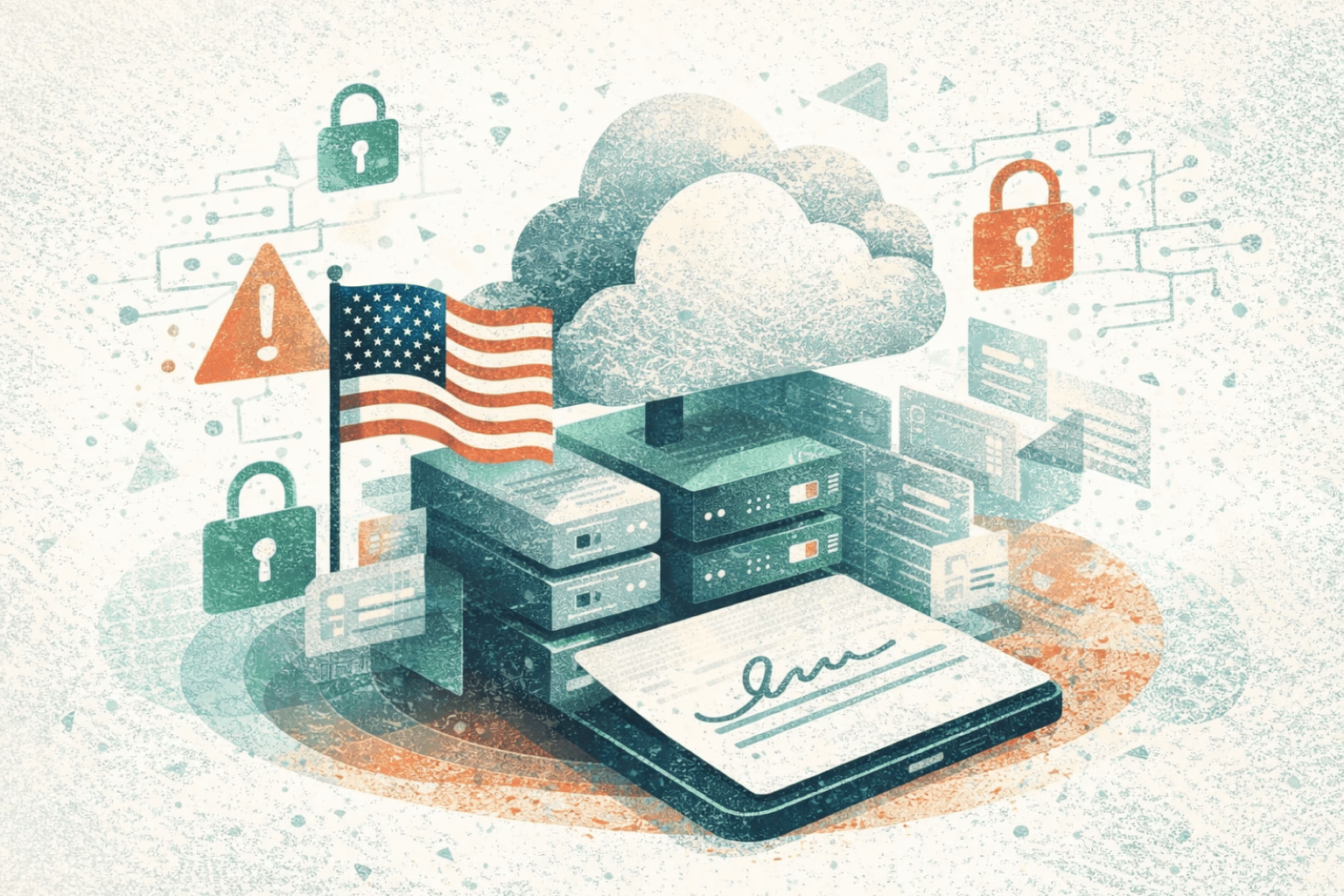
Simple CRM approaches security as a full-stack trust architecture: operational GDPR control through Simple RGPD, layered infrastructure protection, encrypted redundancy across Europe, and a sovereign European posture designed to reduce exposure to extraterritorial legal regimes such as the US Cloud Act.
The Simple CRM approach to GDPR is not rhetorical. It is procedural. The platform positions Simple RGPD as a working module that helps companies manage consent, access rights, deletion requests, and compliance reporting, while structuring the organisation through a concrete six-phase discipline of responsibility, audit, security review, and correction.
Begin with a named GDPR owner and a governance logic, rather than treating compliance as a last-minute legal checkbox.
Map data sources, storage reasons, and data-handling practices so the organisation knows what it keeps and why it keeps it.
Handle consent, access, rectification, deletion, portability, and compliance reporting within the CRM environment.
Use the module as a practical support system for remediation rather than a passive repository of obligations.
The infrastructure pages allow a strong premium argument: Simple CRM does not reduce security to a generic statement. It presents a stack that includes encrypted communications, encrypted stored data, redundant servers, multiple encrypted backups across Europe, and an integrated antivirus layer in Business+ to help reduce document-borne threat exposure.
The “Why trust Simple CRM?” page reinforces the right philosophy for this section. Trust is not a trophy. It is a property of usage. A CRM becomes trustworthy when it is adopted without friction, when it keeps decisions readable, and when it makes the organisation more predictable, not more fragile.
Security is not just about preventing intrusion. It is about protecting continuity, preserving clarity, and ensuring that the system does not become a silent risk for the organisation.
A system that is too complex, avoided by teams, or bypassed in practice creates hidden operational risk.
Security and trust improve when priorities, interactions, and next actions stay visible across the organisation.
A control-tower logic linking relationship, execution, and proof makes the business more predictable and more governable.
The true premium outcome is simple: fewer surprises, less tool chaos, and a system that respects the organisation’s time.
This page should speak clearly about sovereignty. For European organisations, security is not only technical. It is geopolitical. If a provider is subject to an extraterritorial legal regime, then “data hosted in Europe” may still not mean “data shielded from foreign access.” That is why a 100% European and independent position matters strategically, not symbolically.
Present Simple CRM as a European alternative for organisations that want infrastructure logic aligned with European governance and European strategic interests.
Explain clearly that a US legal perimeter can create access risk for data even when the servers themselves are located outside the United States.
Security, compliance, and sovereignty are stronger when the provider’s legal exposure, operating logic, and hosting choices are not structurally dependent on American cloud dominance.
The strategic position expressed in your JDN articles is clear and should be reflected here in a calm but firm way. When US law gives American authorities extraterritorial access rights over data held by companies under US jurisdiction, European firms cannot reduce the issue to pricing, usability, or branding preference. For strategic, industrial, administrative, and sensitive business data, that becomes a structural risk.
Simple CRM is not merely saying “we host in Europe.” It is making a broader trust claim: European companies should not casually place strategic operating memory under foreign legal reach when credible European alternatives exist.
This page is most persuasive when it stays faithful to the brand pillars. Simplicity means reducing security friction without reducing seriousness. Boldness means saying clearly that not all clouds are geopolitically equivalent. Experience means anticipating where risk really comes from. Premium means giving clients a platform they can trust enough to stop worrying about every layer of the stack every day.
Consent, rights, audits, and reports move from theory to a practical operating discipline.
Encryption, redundant servers, antivirus, and multiple encrypted backups across Europe reinforce continuity in real operating conditions.
For EU organisations, independence from US extraterritorial reach is not ideology. It is part of the security model.
That is the Simple CRM position: operational GDPR control with Simple RGPD, layered infrastructure security, encrypted resilience across Europe, and a sovereign European posture designed for organisations that take trust seriously.